An open inspection is a performance. The lights are on, the music is playing, the house smells like fresh coffee and possibly vanilla candles, and the agent is ready with a smile and a property brochure. Everything has been arranged to make you fall in love with the place in under 20 minutes.
Your job is to not fall for it.
A professional building and pest inspection is essential before you buy — that is non-negotiable. But by the time you are paying $500 to $800 for a formal inspection, you should have already weeded out the obvious lemons. The open inspection is your first filter, and learning to read a property like a building inspector reads a report can save you thousands in wasted inspection fees and, more importantly, stop you from buying a money pit.
Here is what to look for, what to ask, and what should send you straight back to the car.
Before You Walk Through the Door
The inspection starts before you step inside. The exterior of a property tells you more than most people realise, and it is the part that sellers are least likely to have staged.
The foundations
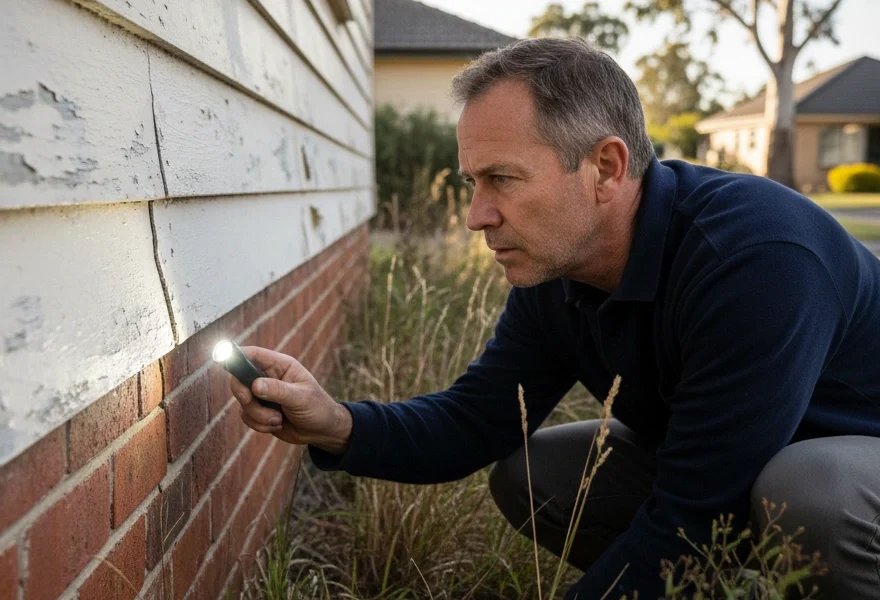
Walk around the entire perimeter of the building and look at where the walls meet the ground. Cracks in the foundation are the single biggest red flag in any property inspection. Hairline cracks under one millimetre are generally cosmetic and not a major concern. But wider cracks — particularly horizontal cracks, stair-step cracks in brickwork, or cracks that you can fit a coin into — can indicate serious foundation movement.
Foundation problems are expensive to fix. Depending on the severity, structural underpinning can cost anywhere from $10,000 to $60,000 or more. In areas with reactive clay soils — common across much of Sydney’s western suburbs, Melbourne’s west, and large parts of Adelaide — foundation movement is one of the most frequent structural issues.
Also look for any recent render or patchwork around the base of the building. Fresh patching over old cracks does not fix the underlying problem — it just hides it for long enough to get through the sales campaign.
The roof
You do not need to climb onto the roof, but you can learn a lot from the ground. Look for missing or cracked tiles, rust spots on metal roofing, and any areas where the roofline appears to sag or dip. A sagging roofline can indicate failed roof timbers, which is a major structural issue.
Check the gutters and downpipes. Are they rusted, sagging, or disconnected? Poor guttering leads to water cascading down the walls and pooling around the foundations — which brings us back to that foundation movement problem. Water is the enemy of every house, and a property that does not manage water well is a property with a ticking clock.
The drainage and surroundings
Look at how the land around the property slopes. The ground should fall away from the building on all sides, directing water away from the foundations. If the garden slopes toward the house, or if you can see pooling or waterlogged areas near the walls, that is a drainage problem that will cause damage over time.
Check the fence lines and any timber structures around the property for termite damage. Termites are one of the most destructive forces in Australian housing, causing an estimated $1.5 billion in damage to Australian homes each year according to the CSIRO. Look for mud tubes (pencil-thin brown lines running up walls or posts), hollow-sounding timber, and any areas where wood appears to be deteriorating or crumbling. Properties near bushland, parks, or with established gardens are at higher risk.
The Walls and Ceilings: Reading the Cracks
Once inside, resist the urge to admire the kitchen benchtops and start looking at the bones of the place. Walls and ceilings are the first things to inspect — and the place where problems are most often hidden behind a fresh coat of paint.
Cracks that matter
Not all cracks are created equal. Here is how to tell the difference.
Hairline cracks in plaster, particularly around doorframes and where walls meet ceilings, are common in most Australian homes. They are usually caused by normal settling and seasonal movement and are rarely a structural concern. These are cosmetic.
Diagonal cracks running from the corners of windows or doors at roughly 45 degrees are more concerning. These suggest differential settlement — meaning one part of the foundation is moving more than another. This pattern is particularly common in older homes on reactive soils.
Horizontal cracks in brick or block walls are the most worrying. They can indicate lateral pressure on the wall, often from soil movement or water pressure, and may suggest a serious structural problem that requires engineering assessment.
Cracks that have been recently filled or painted over deserve extra suspicion. Run your hand along the wall. If you can feel ridges where filler has been applied, the seller may be covering up known movement. It does not mean the house is unsalvageable, but it does mean you need a structural engineer — not just a general building inspector — to assess it.
The door and window test: Try opening and closing every door and window in the house. If doors stick, fail to latch, or swing open on their own, it can indicate that the frames are no longer square — a sign of structural movement. Similarly, windows that jam or have visible gaps around the frame suggest the building has shifted. This takes 60 seconds and costs nothing.
Water stains and damp
Look up. Water stains on ceilings — yellowish-brown marks, bubbling paint, or sagging plaster — indicate past or current leaks. A stain does not necessarily mean the leak is still active, but it does mean water has entered the building at some point, and you need to know whether the cause has been fixed.
Check the walls, especially in bathrooms, laundry areas, and around windows. Peeling paint, mould spots, and a musty smell all point to moisture problems. Waterproofing failures are the single most common building defect in Australian homes, accounting for roughly 40 per cent of all reported defects in apartment buildings constructed since 2000.
Get down low and check skirting boards. Swelling, discolouration, or warping at the base of walls suggests rising damp — water being drawn up from the ground through the masonry. Rising damp is treatable but not cheap, and it is often a recurring problem in older properties without adequate damp-proof courses.
The Floors: What Is Happening Underneath
Walk slowly through every room and pay attention to what your feet are telling you. Floors that slope noticeably, bounce underfoot, or creak excessively can indicate problems ranging from minor (loose boards) to major (failed stumps or bearers).
In older homes, particularly those built on timber stumps, uneven floors are extremely common. The stumps deteriorate over time — especially in damp conditions — causing the floor to drop in sections. Re-stumping a typical three-bedroom weatherboard house can cost $10,000 to $25,000 depending on access and the number of stumps involved.
If the property has been recently renovated, be especially attentive. New flooring can hide a multitude of sins. Beautiful new timber or tile over a failing subfloor is lipstick on a pig. If you can, peek under the house through any accessible subfloor areas. A dry, well-ventilated subfloor with intact stumps and no standing water is a good sign. A subfloor that smells damp, shows signs of mould, or has visibly deteriorating timbers is a concern.
For concrete slab homes, look for cracking in floor tiles, especially in a pattern that follows straight lines — this can indicate the slab itself has cracked beneath the surface.
Plumbing: Turn Everything On
Most buyers feel awkward testing taps and flushing toilets at an open inspection. Get over it. Testing the plumbing takes five minutes and can reveal issues that cost thousands to fix.
Turn on every tap. Check water pressure in the kitchen, bathroom, and laundry. If the pressure drops significantly when multiple taps are running simultaneously, the property may have undersized pipes, corroded galvanised pipes (common in pre-1970s homes), or a supply issue.
Check the water colour. Brown or rusty water when you first turn on a tap suggests corroded pipes. Clear water is good; anything else warrants investigation.
Look under every sink. Crouch down and check for leaks, corrosion, staining, or temporary repairs (silicon sealant smeared over joints, buckets placed under pipes). These are signs of deferred maintenance or active problems.
Flush every toilet. Check that they fill and flush properly. A toilet that runs continuously after flushing usually needs a new valve — a minor fix. But a toilet that does not flush at all, or that drains slowly, could indicate a blocked sewer line — which is a major and expensive problem.
Check the hot water system. Is it gas, electric, or solar? How old is it? Hot water systems have a lifespan of roughly 8 to 12 years. If the system looks original and the house was built 15 years ago, budget $1,500 to $3,000 for a replacement in the near term.
Electrical: Safety First
Electrical faults are not just expensive — they are dangerous. Australian homes must comply with the wiring rules set out by Standards Australia, and outdated wiring is both a safety hazard and a barrier to insurance.
Flick every light switch. If any do not work, it could be a blown bulb or it could indicate a wiring fault. Check the switchboard — if the property still has old ceramic fuses rather than modern circuit breakers, the entire switchboard likely needs upgrading (typically $2,000 to $4,000). Old switchboards may also lack safety switches (residual current devices), which are now mandatory for power circuits in most states.
Count the power points in each room. Older homes often have far fewer power points than modern families need, leading to overloaded circuits and extension cord spaghetti. Adding power points during a renovation is not hugely expensive, but if the existing wiring is old, the electrician may recommend a full rewire — which is.
Look at the condition of visible wiring, particularly in garages, laundries, and outdoor areas. Frayed, discoloured, or exposed wiring is a serious safety hazard and an immediate red flag. Any electrical work you can see that looks amateurish — improvised connections, cables run along surfaces rather than through walls — suggests DIY work that may not be compliant or safe.
The Nose Knows: Smells That Signal Trouble
Your nose is one of the most useful tools at an open inspection, and sellers know it. That is why the coffee is brewing and the candles are burning — they are trying to overpower smells that would otherwise tell you something important.
Musty or damp smell: This is the most common problem smell and indicates moisture, mould, or poor ventilation. It is most noticeable in bathrooms, laundries, subfloor areas, and rooms that do not get much airflow. Mould is not just a building issue — it is a health issue, particularly for people with respiratory conditions or allergies.
Fresh paint smell: This is not inherently bad — people do paint before selling. But if the entire house smells like fresh paint and the walls look freshly done, ask yourself what is being covered up. Fresh paint over water stains, mould, or crack repairs is one of the oldest tricks in the renovation-for-sale playbook.
Sewage smell: A faint sewage smell, particularly in bathrooms or near drains, can indicate broken sewer pipes, failed traps, or inadequate venting. This is not a cosmetic issue — it is a health hazard and potentially an expensive repair.
Animal smells: Pet odours that have soaked into carpet, underlay, and even floorboards can be extremely difficult and costly to remove. If the carpet smells despite appearing clean, the underlay or the floor beneath may be saturated. Budget for replacement if you proceed.
The Renovation Flip: When Pretty Hides Problems
Some of the most dangerous properties to buy are the ones that look the best. A cosmetic renovation — new kitchen, new bathroom, fresh paint, new flooring — can transform a tired property into something that photographs beautifully and sells fast. But a cosmetic renovation does not fix structural problems, plumbing issues, electrical faults, or pest damage. It just makes them harder to see.
Be especially cautious with properties that have been recently purchased, renovated, and relisted within 12 to 18 months. This is the classic investor flip, and while some flippers do quality work, many are focused on minimising renovation costs to maximise profit margin. That means cheap materials, corners cut, and problems concealed rather than fixed.
Things to watch for in a recently renovated property:
Ask about council approvals. Any structural work, plumbing changes, or electrical modifications require permits from the local council. If the renovation involved moving walls, adding a bathroom, or changing the layout, ask to see the council approval and the certificate of compliance. Unapproved work can create serious problems — councils can order you to remove it or bring it up to code, at your expense, and your insurer may refuse to cover damage related to unapproved modifications. You can check what approvals have been granted for a property through your local council or through the relevant state planning portal.
Look behind the cosmetics. Open cupboard doors and check the quality of the work underneath. Pull out drawers and look at how they are made. Check whether tiles are properly grouted and sealed, especially in wet areas. A cheap renovation often looks good on the surface but reveals poor workmanship when you look at the details.
Check the waterproofing certificate. If the bathroom has been renovated, the waterproofing must have been done by a licensed waterproofer and a certificate of compliance should exist. Without it, if the waterproofing fails (and cheap waterproofing often does), you have no warranty protection and a water damage bill that can easily run into five figures.
Strata Properties: The Extra Layer
If you are inspecting an apartment, townhouse, or any strata-titled property, everything above still applies — but there is an additional layer of due diligence that is equally important.
Common areas tell you everything. The condition of the hallways, stairwells, car park, and grounds reflects how well the owners corporation manages the building. Peeling paint in corridors, broken tiles in the foyer, and poorly maintained gardens suggest a building where maintenance has been deferred — and deferred maintenance eventually becomes expensive special levies.
Ask about the strata levies. How much are they? Have they increased recently? Are there any special levies planned or anticipated? A strata report (typically $200 to $400) will give you the full picture, but the agent should be able to tell you the current quarterly levy at the open inspection.
Check for building defects notices. Has the building had any defect rectification work? Is there any ongoing litigation with the builder or developer? Are there any outstanding building orders from the council or state building commissioner? All of this should be disclosed in a strata report, but asking the question at the open inspection can sometimes reveal information the agent was not planning to volunteer.
The NSW Fair Trading website provides guidance on strata property rights and what information you are entitled to before purchasing. Other states have equivalent resources through their consumer affairs departments.
Questions the Agent Hopes You Will Not Ask
Most open inspection conversations are superficial — “lovely kitchen,” “great light,” “how long has it been on the market?” Here are the questions that actually matter.
“Why is the owner selling?” The answer may not be truthful, but it can still be revealing. A motivated seller (divorce, relocation, financial pressure) may accept a lower offer. An answer that is vague or evasive might indicate something the agent does not want to disclose.
“How long has the property been on the market?” A property that has been listed for months in an active market may have a problem — price, condition, or location — that other buyers have already identified.
“Are there any known defects or issues with the property?” Agents have a legal obligation not to misrepresent the property. Asking directly puts the question on record. If they say no and you later discover a known issue, you may have legal recourse.
“Has there been any flood, fire, or storm damage?” Flood and storm history can affect insurance costs dramatically. Properties in flood-prone areas can face insurance premiums several times higher than comparable properties on higher ground. You can check flood mapping through your state emergency service or local council websites.
“What are the neighbours like?” The agent will never say the neighbours are terrible. But their body language when you ask can be informative. Also check whether the property is near any potential noise sources — arterial roads, train lines, flight paths, pubs, or commercial premises — that might not be obvious during a Saturday morning inspection.
“Has any work been done without council approval?” If the answer is yes, or if the agent is unsure, that is a significant concern. Unapproved work affects insurance, resale value, and potentially your legal liability as the new owner.
Your Open Inspection Toolkit
Bring these to every open inspection and you will immediately be better prepared than 90 per cent of buyers in the room.
Your phone camera. Photograph everything — cracks, stains, the switchboard, the hot water system, the roof from the street, any areas of concern. Review the photos later when you are not caught up in the excitement of the visit. Most people forget details within hours.
A small torch. Shine it into the subfloor (if accessible), inside cupboards, and into any dark corners where problems like damp, mould, or pest damage may be hiding. The phone torch works in a pinch but a proper small torch is better.
A marble or small ball. Place it on the floor and see if it rolls. A slight roll is normal in older homes. A marble that shoots across the room indicates significant floor slope — which means foundation issues.
A printed checklist. Write down the key things to inspect before you arrive. In the excitement of an open inspection, it is easy to forget to check the switchboard, test the taps, or look at the roof. A checklist keeps you disciplined.
A tape measure. If you are serious about the property, measure the rooms. Floorplans provided by agents are often optimistic with dimensions. A room that looks spacious when empty may not fit your furniture.
When to Walk Away
Not every red flag is a deal-breaker. Most properties have some issues, and many problems are fixable at a reasonable cost. The question is whether the cost of fixing the issues is reflected in the asking price.
However, there are some red flags that should give you serious pause — or send you straight to the next listing.
Significant structural cracking combined with evidence of previous repairs suggests an ongoing and potentially worsening problem. One round of foundation repair is manageable. Repeated repairs indicate a property that may never be stable.
Active termite infestation. Evidence of current termite activity (not just old damage that has been treated) means the property needs immediate professional treatment and potentially significant timber replacement. The visible damage is almost always the tip of the iceberg.
Extensive mould or rising damp throughout the property, rather than isolated to one area, suggests a systemic moisture problem that may be prohibitively expensive to resolve.
Unapproved structural work where the seller cannot or will not obtain retrospective approval. You inherit this problem — and the cost of making it right — if you buy.
Multiple major defects. Any one problem on its own might be manageable. But if the building inspection comes back with foundation movement, roof issues, plumbing problems, and electrical defects, you are not buying a home — you are buying a renovation project at a finished-home price.
The Bottom Line
An open inspection is not a casual stroll through someone else’s house. It is your first opportunity to assess whether a property is worth the hundreds of thousands — or millions — of dollars the seller is asking for it.
Treat every open inspection like a job. Bring your checklist, your torch, and your scepticism. Look past the styling and the staging. Get down on your knees and look at skirting boards. Stick your head in cupboards. Turn on every tap and flush every toilet. Ask the uncomfortable questions. And if something does not feel right, trust your instincts.
A good building inspector, hired through organisations like the Australian Institute of Building Surveyors, will find the things you miss. But by doing your own homework at the open inspection, you will avoid wasting money on inspections for properties that were never worth pursuing — and you will walk into every negotiation knowing exactly what you are buying.
Disclaimer: This article provides general information only and is current as of February 2026. Building standards and disclosure requirements vary by state and territory. This is not professional building advice. Always engage a licensed building inspector before committing to any property purchase.