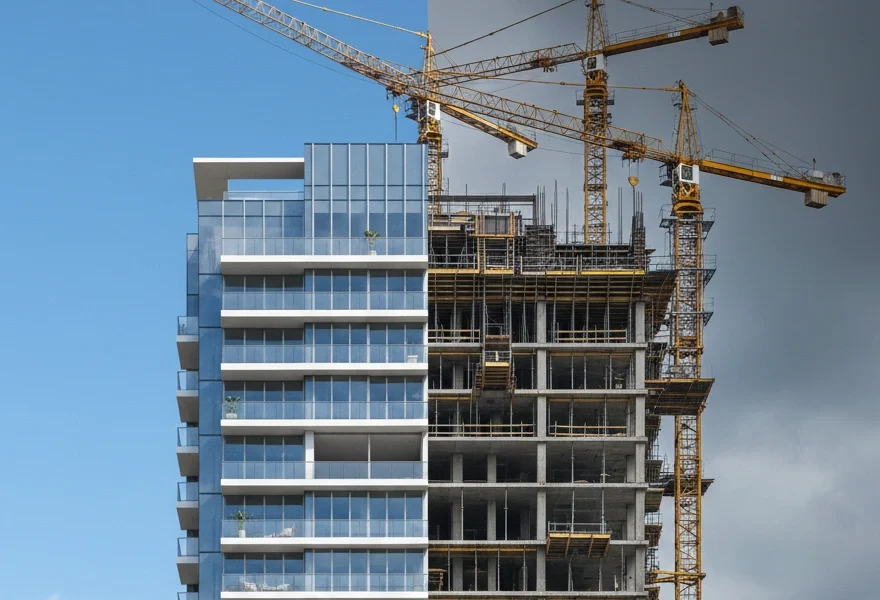
Open any property section on the weekend and you will see them. Glossy renders of gleaming apartment towers, rooftop pools, and floor-to-ceiling windows overlooking a harbour that only the penthouse can actually see. The pitch is always the same: lock in today’s price, enjoy stamp duty savings, claim depreciation benefits, and watch your equity grow while the building goes up.
It sounds compelling. And for some buyers, in some markets, at some moments in time, buying off the plan has genuinely worked out. But the reality is far more complicated than the brochures suggest — and the risks are far greater than most buyers understand when they put their deposit down.
This is not a hit piece on off-the-plan purchasing. It is a sober assessment of the genuine advantages, the serious risks, and the questions you need to answer honestly before committing to buy a property that does not yet exist.
What Off-the-Plan Actually Means
Buying off the plan means signing a contract to purchase a property — usually an apartment, townhouse, or house-and-land package — before it has been built or while it is still under construction. You are buying a promise based on architectural plans, marketing renders, and a display suite.
The typical process works like this. You pay a deposit, usually 10 per cent of the purchase price, when you sign the contract. The developer uses your commitment (along with those of other buyers) to secure project financing from their lender. Construction proceeds over the next 12 to 36 months — sometimes longer. When the building is complete and the strata plan is registered, you settle the purchase by paying the remaining balance, usually with a mortgage.
Between the day you sign and the day you settle, a lot can happen. Markets move. Interest rates change. Lending criteria tighten. Building quality may not match expectations. And the developer’s glossy brochure is not a legally binding guarantee of what you will actually receive.
The Genuine Advantages
To be fair, there are legitimate reasons why some buyers choose off-the-plan purchases. Understanding these advantages — and their limitations — is important for an honest assessment.
Stamp duty concessions
This is the single biggest financial incentive and the one that drives the most off-the-plan purchases. Most states offer stamp duty concessions for new properties purchased off the plan, and for first home buyers especially, these savings can be substantial — often tens of thousands of dollars.
In Victoria, for example, an off-the-plan stamp duty concession (extended until October 2026) allows the dutiable value to be reduced by deducting the construction costs not yet completed at the date of the contract. In NSW, first home buyers pay zero stamp duty on new homes valued at $800,000 or less. WA offers a full exemption for off-the-plan properties up to $750,000.
These are real savings. But they need to be weighed against the risks, because a $20,000 stamp duty saving is cold comfort if your property settles at a value $80,000 below what you paid.
Depreciation benefits for investors
New properties allow investors to claim depreciation on both the building structure and the fixtures and fittings. A quantity surveyor’s depreciation schedule for a new apartment can deliver $8,000 to $15,000 or more in tax deductions in the first year alone, depending on the property value and fit-out quality.
This is a genuine advantage for investors in higher tax brackets, and it does not exist for established properties (where the depreciation on plant and equipment was effectively removed for second-hand assets from 2017). However, depreciation is a tax deduction, not free money — it reduces your taxable income, but you still need the underlying investment to perform.
Time to save
Because settlement does not occur until the building is complete (often 18 to 36 months after signing), buyers have additional time to save towards the balance. This can be helpful for first home buyers who need to build their deposit further, though it also means your money is committed without you owning anything in the interim.
New home with warranty protections
Brand-new apartments come with statutory warranty protections. The specifics vary by state, but generally builders must rectify structural defects for up to six years and non-structural defects for two years. In NSW, the Strata Building Bond and Inspections Scheme holds a 2 per cent construction cost bond specifically for defect rectification found in the first 18 months.
These protections are valuable — in theory. In practice, as we will explore shortly, enforcing them can be a different story.
The Risks Nobody Puts in the Brochure
Now for the part the developers and their sales agents would prefer you did not read.
Valuation shortfall: the settlement trap
This is the risk that has burned more off-the-plan buyers than any other. When you signed the contract two years ago, you agreed to pay $750,000 for a two-bedroom apartment. The market was strong, the area was hot, and the developer’s price felt reasonable.
Two years later, you apply for your mortgage. Your lender sends a valuer to assess the completed apartment. The valuer looks at recent comparable sales in the area — which now includes dozens of identical apartments in the same building, all hitting the market at once — and values your apartment at $680,000.
You now have a $70,000 problem. Your lender will only provide a mortgage based on the lower valuation, which means you need to find an additional $70,000 in cash to make up the difference, or renegotiate your loan at a much higher loan-to-value ratio (which means higher interest rates and lenders mortgage insurance).
This is not a hypothetical scenario. One Sydney apartment complex saw 84 per cent of all bank valuations come in below the contracted sale price at settlement. Many buyers who could not cover the shortfall had to walk away entirely, forfeiting their deposits.
Valuation shortfalls happen for several reasons: the market may have softened during construction, the developer may have priced the apartments above their true market value to inflate the project’s financial viability, or the flood of new supply from the completed building itself may push local prices down.
Building defects: the 85 per cent problem
Research by the UNSW City Futures Research Centre found that up to 85 per cent of apartment buildings constructed since 2000 in NSW contain at least one significant defect. Waterproofing failures alone account for roughly 40 per cent of all reported issues.
A 2023 NSW Government study confirmed that 53 per cent of strata buildings registered between 2016 and 2022 had serious defects, with average repair costs reaching $331,829 per building. These are not cosmetic complaints about paint colours. We are talking about water leaking through walls, structural cracking, fire safety non-compliance, and defective plumbing.
The Opal Tower incident in Sydney Olympic Park (Christmas Eve 2018) and the Mascot Towers crisis (2019) were dramatic examples, but they represent the visible tip of a much larger iceberg. For every building that makes the news, dozens more have owners quietly dealing with expensive defects and painfully slow rectification processes.
The $2 company problem: Many developers and builders set up separate companies for each project. If your building has defects and the specific project company has been wound up or has no assets, there may be nobody to pursue for rectification — even if the same people are building another tower down the road under a different entity name. Always check the developer’s track record across multiple projects, not just the entity name on your contract.
What you signed up for may not be what you get
Off-the-plan contracts are drafted by the developer’s lawyers to protect the developer’s interests. And buried in those contracts are clauses that most buyers do not fully appreciate until it is too late.
Variation clauses allow the developer to substitute materials, appliances, and finishes with alternatives of “similar quality” — a subjective standard that often results in cheaper substitutions. The marble benchtop in the display suite becomes reconstituted stone. The European appliances become a budget brand. The timber flooring becomes laminate.
Dimension tolerances mean the apartment you receive may be smaller than the one shown in the plans. A 5 per cent variation on a 70-square-metre apartment is 3.5 square metres — roughly the size of a small bedroom. Some contracts allow even greater variation before the buyer has any recourse.
View obstruction is another common complaint. The marketing material showed sweeping harbour views, but the contract probably did not guarantee them. If another development is approved next door during construction, your view can disappear entirely — and there is nothing you can do about it.
Sunset clauses: the developer’s escape hatch
A sunset clause sets a deadline by which the development must be completed. If the project is not finished by that date, either party can terminate the contract. Sounds reasonable — it protects you if the project stalls indefinitely.
The problem is that in a rising market, some developers have been known to deliberately delay projects to trigger the sunset clause, cancel buyer contracts at the original price, and then re-sell the same apartments at a higher price. NSW and Victoria have introduced laws requiring developers to obtain Supreme Court approval before exercising a sunset clause, but the risk has not been entirely eliminated.
Check the sunset clause dates in your contract carefully, and be aware that if the developer triggers the clause, you get your deposit back — but you have lost years of potential capital growth on a property you could have purchased elsewhere.
Construction delays
Delays are not the exception in apartment construction — they are the norm. Supply chain disruptions, labour shortages, weather events, council approval hold-ups, and developer financial difficulties all contribute to projects running months or even years behind schedule.
One Sydney CBD apartment building commenced off-the-plan sales in 2013 with a planned completion around 2017-18. It was not actually completed until 2021. Buyers who planned their lives around the original timeline — selling existing homes, ending leases, relocating for work — were left in limbo for years.
During those delays, your deposit sits in a trust account (hopefully), you cannot move in, you cannot rent it out, and you are paying for your current housing while waiting for a property that may never arrive on time.
Settlement risk: when your finances change
When you signed the contract, your income was stable, interest rates were at a certain level, and your bank pre-approved your loan. But pre-approvals typically expire after three to six months, and a lot can change in the 18 to 36 months between signing and settlement.
You might change jobs, take parental leave, or experience a drop in income. Interest rates might rise, reducing your borrowing capacity. Lending criteria might tighten — APRA has periodically instructed banks to increase serviceability buffers, which can suddenly disqualify borrowers who would have qualified months earlier.
If you cannot secure finance at settlement, you are in breach of contract. The developer can terminate and keep your deposit — potentially tens of thousands of dollars lost with nothing to show for it.
The Developer Margin Problem
There is a fundamental economic reality that off-the-plan buyers need to understand. When you buy an established property, you are paying market value based on comparable sales. When you buy off the plan, you are paying market value plus the developer’s profit margin, marketing costs, sales commissions, and project risk premium.
This margin can be 20 to 30 per cent or more of the property’s actual construction and land cost. That means your apartment needs to appreciate by that margin just for you to break even compared to what an equivalent established apartment would have cost.
This is why many property analysts note that off-the-plan apartments often show little or no capital growth for up to a decade after purchase. The developer has already captured the future growth in their sale price. You are, in effect, buying at retail and hoping the market catches up.
Current market conditions have made this worse. Profit margins on apartment projects now sit below 5 per cent for many developers, leaving almost no buffer for cost overruns. This means developers are under enormous pressure to cut costs on materials and finishes — pressure that ultimately manifests as the building quality issues discussed above.
When Off-the-Plan Can Actually Work
Despite everything above, there are specific circumstances where buying off the plan can be a rational decision. The key is understanding what those circumstances are and being honest about whether they apply to you.
You are buying in a genuinely supply-constrained market
In some locations, particularly desirable inner-city pockets with very limited land for new development, off-the-plan apartments in a quality building can perform well because new supply is naturally restricted. If you are buying in a small boutique development in an established suburb with high owner-occupier demand, the dynamics are very different from buying in a 300-unit tower on a former industrial site surrounded by five other identical towers.
The developer has a strong track record
Some developers consistently deliver quality buildings. Before signing anything, research the developer’s previous projects. Visit completed buildings they have built. Talk to owners. Check online forums and owners corporation records for complaints about defects. A developer with a decade of quality completions is a very different proposition from one with no history.
You can check developer and builder licence details through your state’s building authority. In NSW, that is the NSW Building Commissioner’s office. In Victoria, check with the Victorian Building Authority. In Queensland, the Queensland Building and Construction Commission maintains a searchable register of licenced builders and records of disciplinary action.
You are an owner-occupier who genuinely wants to live there
If you are buying a specific apartment in a specific building because it suits your lifestyle — the right suburb, the right size, the right orientation, near your work — and you plan to live there for at least seven to ten years, the capital growth equation matters less. You are buying a home, not an investment vehicle, and the stamp duty savings and brand-new condition may genuinely suit your situation.
The danger is when people buy off the plan as investors purely for the tax benefits and projected capital growth, without critically assessing whether the underlying asset will actually perform.
The numbers work even in a flat market
Stress-test your purchase against a scenario where the apartment’s value does not increase at all for five years after settlement. Can you still afford the mortgage repayments? Are you comfortable holding an asset that might be worth less than you paid? If the answer is no, the purchase is too dependent on market growth — growth that is never guaranteed, especially for new apartments in high-supply areas.
The Due Diligence Checklist
If you have weighed the risks and still want to proceed with an off-the-plan purchase, here is the due diligence that separates informed buyers from casualties.
Research the developer exhaustively. Google the developer’s name, the directors’ names, and the builder’s name. Search for ASIC records to check for previous company failures. Visit their completed projects. Ask existing owners about their experience — not at the display suite, but through online forums, strata management companies, or by physically visiting the building.
Get independent legal advice. Do not use the developer’s recommended solicitor. Engage your own property solicitor who specialises in off-the-plan contracts. They will identify the clauses that could hurt you — variation powers, sunset clause terms, deposit handling, defects liability provisions, and your rights if the building does not match the plans.
Scrutinise the contract for variation clauses. What can the developer change without your consent? Can they substitute finishes? Can they alter the floor plan? What are the dimension tolerances? Can they change the common areas? The tighter these clauses, the better protected you are.
Understand the sunset clause. When does it expire? What happens if the project is delayed? In NSW and Victoria, the developer generally needs court approval to exercise a sunset clause — but check that this protection applies to your specific contract.
Check how the deposit is held. Your deposit should be held in a trust account or controlled money account, not used by the developer as working capital. If the developer has access to your deposit and goes into administration, recovering your money can be extremely difficult. The Australian Securities and Investments Commission (ASIC) maintains records of company insolvencies and director histories that can help you assess developer risk.
Do not rely on the display suite. Display suites are marketing tools. They are designed to make the apartment feel larger, brighter, and more luxurious than the standard product. The display suite might feature upgraded finishes, premium appliances, and clever furniture placement that would never fit in the actual apartment. Ask the developer for the detailed specification list — every material, every appliance, every fitting — and compare it to what you see in the display suite.
Get a building report on completion. Before settlement, arrange for an independent building inspector to assess the completed apartment. They will identify defects, unfinished work, and anything that does not match the contract specifications. Do this before you settle, because your negotiating power drops dramatically once you own it.
Check the body corporate budget. For strata-titled apartments, review the proposed budget for the owners corporation. Developers sometimes set body corporate levies artificially low to make the ongoing costs look attractive, then owners cop a large increase in the first year once realistic costs are factored in. Get an independent assessment of whether the proposed levies are realistic for the building’s size and facilities.
Alternatives Worth Considering
If the off-the-plan proposition does not stack up after honest analysis, there are alternatives that offer some of the same benefits with fewer risks.
Near-new apartments (1 to 5 years old). These give you a modern apartment with many of the same lifestyle benefits, but with one critical advantage: you can see exactly what you are buying. Any initial defects have likely been identified and (hopefully) rectified. The body corporate has a real track record of costs and management quality. And you can check comparable sales data to ensure you are paying a fair market price. You will miss out on some stamp duty concessions available only for new properties, but you avoid the valuation shortfall risk almost entirely.
Small-scale developments. Boutique developments of 10 to 30 apartments tend to have better build quality than large towers, partly because the builder has more incentive to protect their reputation on smaller, more visible projects. They also tend to have stronger owner-occupier ratios, which supports better maintenance and resale values.
Established apartments in owner-occupier suburbs. Suburbs where the majority of apartment residents are owner-occupiers (rather than tenants) tend to deliver stronger capital growth over time, because owner-occupiers drive prices up through emotional purchasing while investor-heavy buildings are more price-sensitive and subject to yield-based valuations.
House-and-land packages. If you want a new home with the associated stamp duty benefits and depreciation advantages, a house-and-land package in an outer suburban growth corridor can offer better value than an inner-city apartment. You get actual land (with its own scarcity value), a standalone dwelling, and typically a more straightforward construction process. The trade-off is location — you will generally be further from the CBD.
What the Industry Does Not Want You to Know
Successive Australian governments have actively encouraged off-the-plan purchasing through stamp duty concessions, first home buyer grants targeting new dwellings, and favourable depreciation rules. This is not primarily for your benefit — it is to stimulate the construction industry, which is a major employer and economic driver.
The real estate industry has a massive incentive to promote off-the-plan sales. Developer sales commissions for agents are typically higher than for established property sales, and the marketing budgets are larger. When an agent enthusiastically recommends a new development, understand that their commission structure may be influencing that recommendation.
Property spruikers — individuals or companies that promote specific developments to investors, often in exchange for undisclosed commissions from the developer — are a particular danger. They present seminars, run “wealth creation” events, and promote off-the-plan apartments as can’t-miss investment opportunities. The ACCC and state consumer protection agencies have taken action against misleading conduct in this space, but it remains widespread.
If someone is aggressively pushing you toward a specific off-the-plan development and their income depends on you buying it, that is not independent advice. It is a sales pitch dressed up as financial guidance. For genuinely independent property advice, consider engaging a REBAA-accredited buyer’s agent who works exclusively for buyers and has no relationship with the developer.
The Bottom Line
Off-the-plan apartments are not inherently bad investments. But they are inherently riskier than established property purchases, and the industry systematically downplays those risks because it profits from your participation.
The buyers who do well with off-the-plan purchases are typically those who buy in supply-constrained locations from reputable developers, get thorough independent legal advice, stress-test their finances against worst-case scenarios, and plan to hold the property for a decade or more.
The buyers who get burned are typically those seduced by glossy marketing, attracted by stamp duty savings without weighing the countervailing risks, buying in oversupplied investor-heavy locations, or relying on capital growth that may never materialise.
Before you sign anything, ask yourself this: if this same apartment were available as an established property at the same price, would you still buy it? If the answer is no — if the only appeal is the newness, the tax benefits, and the projected future value — that should give you serious pause. Those benefits may not be enough to compensate for the risks you are taking on.
And whatever you decide, get independent legal advice before you sign. Not the developer’s lawyer. Not the agent’s recommendation. Your own solicitor, who works for you and has no interest in the deal going ahead. That one decision alone could save you hundreds of thousands of dollars — or save you from making the purchase in the first place.