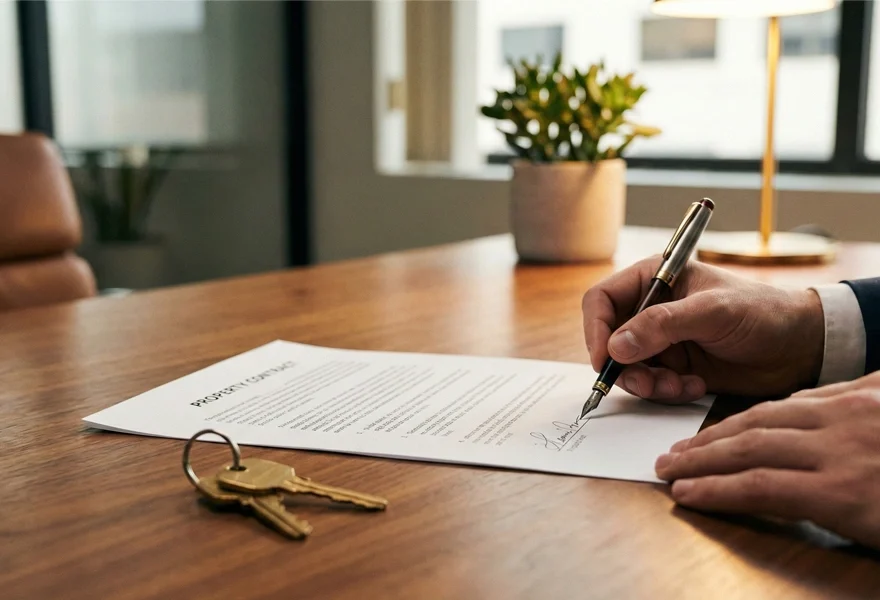
You have found the house, made an offer, and the agent just called to say it has been accepted. Congratulations. Now the real process begins — and it is the part that almost nobody understands until they are in the middle of it.
Conveyancing is the legal process that transfers ownership of a property from the seller to you. It starts when your offer is accepted and finishes when you collect the keys on settlement day. In between, there are contracts to review, searches to conduct, money to arrange, and about a dozen points where things can go sideways if you are not paying attention.
The whole process typically takes four to eight weeks, though it can stretch longer depending on complexity, lender delays, or issues uncovered during searches. Most buyers hire a conveyancer or property solicitor to handle it, and for good reason — the legal requirements are strict, the documents are dense, and the consequences of getting it wrong are expensive.
Here is what actually happens at each stage, in plain English.
Stage 1: Engaging a Conveyancer
The first thing you should do — ideally before you even start making offers — is engage a conveyancer or property solicitor. This is the person who will protect your legal interests throughout the entire transaction.
A conveyancer is a licensed professional who specialises in property transfers. A property solicitor does the same work but is also a qualified lawyer, which means they can provide broader legal advice if complications arise. For a straightforward purchase, either will do the job. For anything complex — unusual contract clauses, off-the-plan purchases, properties with caveats or easements — a solicitor is usually worth the extra cost.
Conveyancing fees in Australia typically range from $800 to $2,500 for a standard residential property, depending on your state and the complexity of the transaction. This does not include the cost of searches (more on those shortly), which are usually billed separately.
You can find licensed conveyancers through the Australian Institute of Conveyancers, which has state branches and maintains directories of accredited professionals. Alternatively, ask your mortgage broker or solicitor for a referral — they work with conveyancers regularly and will know who is reliable.
Tip: Engage your conveyancer before you sign anything. If an agent presents you with a contract at an open inspection or after a verbal offer, do not sign it on the spot. Take it home, send it to your conveyancer, and let them review it first. Once you exchange contracts, you are legally committed (subject to cooling-off rights in some states), and unwinding a bad contract is far more expensive than a few days of patience.
Stage 2: Contract Review
Once the seller’s agent provides a draft Contract for Sale, your conveyancer reviews it in detail. This is not a rubber-stamp exercise. The contract contains terms and conditions that directly affect your rights, your timeline, and your financial exposure.
Here is what your conveyancer is looking for:
The property details. Does the contract accurately describe what you think you are buying? This includes the land title reference, the property address, and the boundaries. It sounds basic, but errors happen — particularly with subdivisions, newly built properties, or lots with complex title arrangements.
Special conditions. These are additional terms negotiated between buyer and seller. Common examples include making the sale subject to finance approval, subject to a satisfactory building and pest inspection, or requiring the seller to complete specific repairs before settlement. Your conveyancer may recommend adding conditions to protect you, or negotiating changes to conditions that favour the seller.
Inclusions and exclusions. What stays with the property and what does the seller take? Light fittings, curtains, dishwashers, garden sheds — these should be clearly listed. If something is not in the contract, do not assume it comes with the house.
Settlement period. This is the agreed timeframe between exchange and settlement — typically 30 to 90 days, with six weeks being the most common in many states. A shorter settlement benefits the seller (they get their money sooner) and a longer one benefits the buyer (more time to arrange finance and prepare for the move). Your conveyancer will help you negotiate a period that works for your circumstances.
Easements and restrictions. An easement gives someone else a right to use part of your land — a council might have drainage running through your backyard, or a utility company might have the right to access cables. Restrictions on use can limit what you can build or how you can use the property. These are attached to the title and do not disappear when you buy. Your conveyancer checks these carefully because they can significantly affect the property’s value and your plans for it.
In Victoria, the seller must provide a Section 32 Statement (Vendor’s Statement) before the contract is signed. This document discloses key information about the property including title details, planning overlays, building permits, and any outstanding notices. Other states have equivalent disclosure requirements, though the specifics differ. Your conveyancer will review this document and flag anything concerning.
Stage 3: Exchange of Contracts
Exchange is the moment the deal becomes legally binding. Both you and the seller sign identical copies of the contract, those copies are exchanged (hence the name), and you pay your deposit — usually 10 per cent of the purchase price, though 5 per cent can sometimes be negotiated.
The deposit is held in a trust account, typically managed by the real estate agent or the seller’s solicitor, until settlement. It does not go directly to the seller.
Cooling-off periods
In most states, private treaty purchases (but not auctions) come with a statutory cooling-off period after exchange. This gives you a short window to withdraw from the contract if you change your mind or if something comes up during your final checks.
The cooling-off period varies by state. In NSW it is five business days, in Victoria three business days, and in Queensland five business days. In some states, if you exercise your cooling-off rights, you forfeit a small penalty — typically 0.25 per cent of the purchase price in NSW.
Your solicitor can waive the cooling-off period by issuing a certificate (called a Section 66W certificate in NSW). This is sometimes done when you want to make your offer more attractive to the seller, but it removes an important safety net. Only agree to waive cooling off if your finance is unconditionally approved, your building inspection is done, and your conveyancer has completed their review.
Critical: There is no cooling-off period for properties purchased at auction. The moment the hammer falls and you sign, the contract is binding and unconditional. All due diligence must be completed before auction day.
Stage 4: Searches and Checks
After exchange, your conveyancer conducts a series of property searches to verify that you are buying what you think you are buying, and that there are no hidden legal or financial problems attached to the property.
These searches are not optional extras — they are a critical part of protecting your investment. The searches your conveyancer will typically order include:
Title search. This confirms who legally owns the property, the boundaries of the land, and any encumbrances registered against the title — mortgages, caveats, easements, or covenants. This is sourced from your state’s land registry. In NSW that is NSW Land Registry Services, in Victoria it is Landata, and other states have equivalent registries.
Council search (Section 149 certificate in NSW, or equivalent). This reveals zoning information, development applications, building approvals, road widening proposals, and any outstanding orders or notices from the local council. It tells you what you can and cannot do with the property under current planning rules, and whether the council has any plans that might affect it.
Water and sewer search. Confirms the property’s connection to water and sewer infrastructure and whether any sewer mains or stormwater channels run through or near the property. If a sewer line runs through your backyard, it can restrict where you can build extensions.
Strata search (for apartments and units). If you are buying a strata-titled property, this search reveals the body corporate’s financial position, any pending special levies, building defects, by-laws, and meeting minutes. A building with a large outstanding special levy or ongoing defect litigation can be a financial nightmare. This search typically costs $200 to $400 but could save you tens of thousands.
Environmental and contamination searches. Checks whether the land has any history of contamination, is located on or near a contaminated site, or falls within a flood zone or bushfire-prone area. These factors affect insurance costs and can limit future development.
Additional searches may include road and rail proposals, mining subsidence checks (in certain areas of NSW), and heritage listings. Your conveyancer will recommend the searches appropriate for your specific property and location.
The total cost of searches typically runs between $300 and $800, depending on the property type and how many searches are needed. Your conveyancer will usually order these promptly after exchange and review the results for any red flags.
Stage 5: Finance and Lender Preparation
While your conveyancer is handling the legal side, you need to ensure your finance is locked in. If you have a pre-approval from your lender, this is when it transitions to formal (unconditional) approval.
Your lender will order their own valuation of the property to confirm it is worth what you are paying. If the valuation comes in lower than the purchase price, your lender may reduce the amount they are willing to lend — leaving you to make up the difference from your own funds or renegotiate the purchase price with the seller.
Once your loan is formally approved, your lender prepares the mortgage documents for you to sign. They also prepare the funds for settlement, coordinating with your conveyancer on the exact amounts needed on the day.
Finance delays are one of the most common causes of settlement problems. Lenders are not always fast, and if your loan approval takes longer than expected, it can push your settlement date out. Keep in close contact with your broker or lender throughout this period, and let your conveyancer know immediately if there are any delays.
If your contract includes a finance clause (making the sale subject to formal loan approval), you typically have 14 to 21 days to secure approval. If you cannot get finance within that period, the clause allows you to withdraw from the contract with your deposit refunded. This is one of the most important protections a buyer can have in a contract, and your conveyancer should fight to include it if it is not already there.
Stage 6: Pre-Settlement Inspection
In the days leading up to settlement — usually within three to five days — you have the right to conduct a final inspection of the property. This is not a second chance to check for defects. It is specifically to confirm that the property is in substantially the same condition as when you signed the contract.
You are checking that the seller has not damaged anything, that all agreed inclusions (appliances, fittings, etc.) are still there, that the property has been left in a clean and reasonable condition, and that any repairs the seller agreed to have been completed.
If something is wrong — a broken window, missing appliances, or damage from the seller’s moving process — notify your conveyancer immediately. They can negotiate with the seller’s solicitor to have the issue rectified before settlement, or arrange for a financial adjustment to cover the cost of repairs.
Do not skip the pre-settlement inspection. It takes 30 minutes and could save you thousands. Contact the real estate agent to arrange access.
Stage 7: Settlement Day
Settlement day is the final act. It is when ownership officially transfers from the seller to you, the money changes hands, and you get the keys.
In practical terms, your conveyancer coordinates with the seller’s legal representative, your lender, and the seller’s lender (if they have a mortgage to discharge) to ensure everything happens simultaneously. The process is now largely electronic in most states through platforms like PEXA (Property Exchange Australia), which handles the digital transfer of documents and funds.
On settlement day, the following happens:
Your lender releases the loan funds. Your deposit (held in trust since exchange) is released. These funds, combined with any additional money you owe, are transferred to the seller. The seller’s mortgage (if any) is discharged. The transfer of ownership is lodged with the state land registry, registering the property in your name. Stamp duty is paid (if not already paid). Your conveyancer confirms that everything has been completed successfully and notifies you that settlement has occurred.
Once settlement is confirmed, you can collect the keys — usually from the real estate agent’s office — and the property is officially yours.
What your conveyancer handles in the final settlement statement
Before settlement, your conveyancer prepares a settlement adjustment statement. This document calculates the final figures, adjusting for costs that are shared between buyer and seller based on the settlement date.
Common adjustments include council rates (if the seller has prepaid rates for a period that extends beyond settlement, you reimburse them for the unused portion), water rates and usage charges, strata levies for apartments and units, and any other charges specified in the contract.
The statement also accounts for your deposit already paid, stamp duty if being paid at settlement, and your conveyancer’s fees and disbursements. The final figure tells you exactly how much additional money you need to bring to settlement beyond what your lender is providing.
Stage 8: Post-Settlement
After settlement, your conveyancer handles a few final administrative tasks. They confirm that the transfer has been registered with the state land registry, updating the title to show you as the new owner. They ensure stamp duty has been paid (or that you have received any applicable concessions or exemptions). And they provide you with copies of all final documents for your records.
On your end, there are a few things to take care of. Arrange building insurance from settlement day — this is critical, as you are now responsible for the property. Contact your local council and water authority to update the property ownership records. Redirect your mail. And connect utilities in your name.
If you are a first home buyer, this is also when any grants (such as the First Home Owner Grant) are finalised, typically having been applied for through your lender during the finance stage.
Conveyancer vs Solicitor: Which Do You Need?
For a standard residential purchase with no unusual complications, a licensed conveyancer is typically sufficient and may be slightly cheaper than a solicitor. Conveyancers are specifically trained in property transfers and handle them every day.
However, consider using a property solicitor if any of the following apply: the property has complex title arrangements (shared titles, company titles, or leasehold), there are disputes or potential legal issues flagged during searches, you are buying off the plan or purchasing from a developer, the transaction involves a deceased estate, or you need broader legal advice on matters connected to the purchase (such as trust structures for investment properties).
Some firms employ both conveyancers and solicitors, allowing them to escalate to a lawyer if complications arise during the process. This can offer the best of both worlds.
To check that your conveyancer is properly licensed, you can verify their credentials through your state’s regulatory body — for instance, NSW Fair Trading maintains a public register of licensed conveyancers in New South Wales.
State-by-State Differences You Should Know
While the general conveyancing process is similar across Australia, each state has its own legislation, timelines, and quirks. Here are the key differences worth noting.
New South Wales: Cooling-off period is five business days. The seller must provide a contract before or at the time of sale. Stamp duty is calculated by Revenue NSW and must be paid within three months of settlement (or at settlement for most transactions). Electronic settlement via PEXA is now standard.
Victoria: The seller must provide a Section 32 Vendor’s Statement before signing. Cooling-off period is three business days. Victoria has an active underquoting taskforce through Consumer Affairs Victoria. Settlement is typically 30 to 60 days.
Queensland: Cooling-off period is five business days. Contracts commonly include a finance clause of 14 to 21 days. Building and pest inspections are usually a contractual condition rather than something done before exchange. The seller provides a disclosure statement but it is less extensive than Victoria’s Section 32.
South Australia: Cooling-off period is two business days for standard purchases. The seller provides a Form 1 (Vendor’s Statement) with key property information. Settlement periods are commonly four to six weeks.
Western Australia: Settlement is typically four to six weeks. Buyers and sellers commonly sign an Offer and Acceptance form rather than a full contract at the initial stage. Finance and building inspection clauses are standard inclusions.
Tasmania, NT, and ACT each have their own variations. Your conveyancer will guide you through the specifics for your jurisdiction.
Common Mistakes That Delay or Derail Settlement
Even with a good conveyancer, things can go wrong. Here are the most common problems and how to avoid them.
Finance not approved in time. This is the number one cause of settlement delays. Start your loan application early, respond to lender requests immediately, and keep your broker in the loop throughout. Do not change jobs, take on new debt, or make large unexplained deposits into your bank account during the approval process — lenders reassess your finances right up until settlement.
Valuation shortfall. If your lender’s valuation comes in below the purchase price, you may need to find additional funds or renegotiate. Having a buffer in your savings helps protect against this.
Undisclosed defects or issues found during searches. If your conveyancer’s searches reveal problems — contamination, unapproved building works, planned road acquisitions — these need to be resolved before you can safely proceed. Sometimes the seller can rectify the issue; sometimes you may need to renegotiate or walk away.
Seller not ready on settlement day. The seller may not have vacated the property, may not have completed agreed repairs, or their own purchase may have fallen through (creating a chain delay). Your conveyancer can issue notices and pursue remedies, but delays from the seller’s side are frustratingly common.
Missing or incorrect documents. A single missing signature or incorrect detail can hold up settlement. Your conveyancer will be meticulous about this, but make sure you sign and return everything they send you promptly.
A Quick-Reference Timeline
While every transaction is different, here is a rough timeline for a typical residential property purchase in Australia.
Before making an offer: Engage a conveyancer, get finance pre-approved, arrange building and pest inspection if buying at auction.
Offer accepted (Day 1): Seller’s agent provides the contract. Your conveyancer begins their review.
Days 1 to 5: Contract review, negotiation of terms, and preparation for exchange. Building and pest inspection if not yet done.
Exchange (around Day 5 to 10): Contracts signed, deposit paid, cooling-off period begins (if applicable).
Days 10 to 20: Conveyancer orders and reviews property searches. You finalise formal loan approval with your lender.
Days 20 to 35: Lender prepares mortgage documents. Your conveyancer prepares transfer documents and settlement statement. Final adjustments calculated.
Days 38 to 42 (approximately): Pre-settlement inspection conducted. Final settlement statement reviewed and approved.
Settlement day (typically Day 42, or six weeks after exchange): Funds transfer, ownership transfers, keys collected. You are officially a homeowner.
Post-settlement: Transfer registered, stamp duty finalised, insurance and utilities confirmed in your name.
The Bottom Line
Conveyancing is not glamorous, but it is the backbone of every property transaction in Australia. Understanding what happens between offer and settlement gives you the ability to ask the right questions, spot problems early, and avoid the costly surprises that catch unprepared buyers.
The most important decision you will make in this process — after choosing the property itself — is choosing a good conveyancer. Find someone who communicates clearly, responds promptly, and explains things in language you actually understand. A good conveyancer will not just process paperwork; they will protect you from risks you did not even know existed.
And if there is one piece of advice to take away from this entire guide, it is this: engage your conveyancer before you sign anything. Not after the auction. Not after you have exchanged. Before. The few hundred dollars you spend on an early contract review could easily save you tens of thousands down the track.