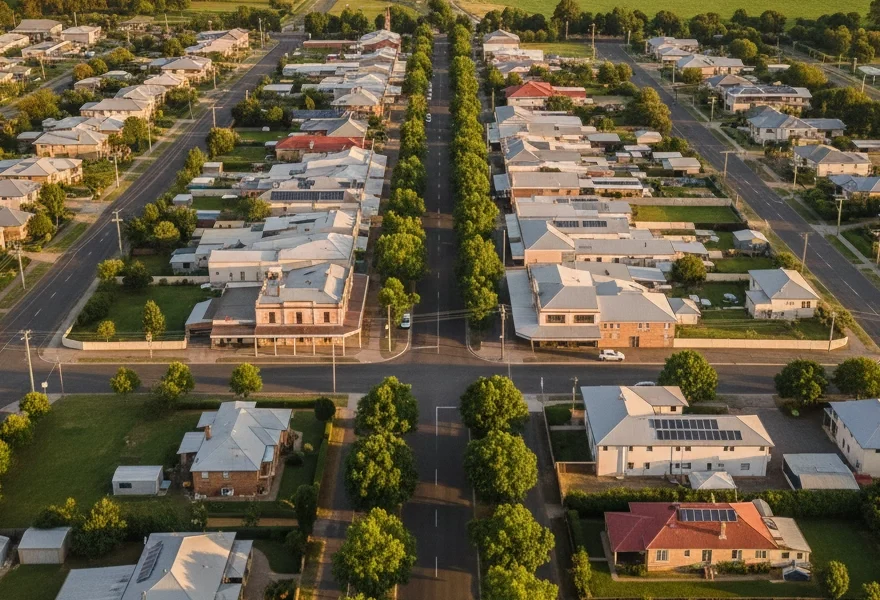
Regional Australia had a moment during the pandemic. City dwellers fled to the coast and the country, armed with remote work arrangements and dreams of a slower pace. Property prices in towns that had barely moved in a decade suddenly jumped 30, 40, even 80 per cent in the space of two years.
Now, in 2026, the dust has settled — and the picture is more complicated. Some of those regional markets have continued to grow, underpinned by genuine economic fundamentals. Others have stalled or softened as the initial wave of tree-changers discovered that country life is not quite the Instagram fantasy they imagined.
The question for buyers today is not whether regional property is worth considering — it clearly is. The question is how to tell the difference between a town with real long-term potential and one that is coasting on hype.
The Numbers Tell a Clear Story
According to Cotality (formerly CoreLogic), the regional Australian property market recorded dwelling value growth of 7.5 per cent in the 12 months to October 2025. That notably outpaced the combined capital cities, which saw a more moderate increase of 5.6 per cent over the same period.
But averages hide enormous variation. The top-performing regional markets saw gains above 20 per cent, while others barely moved or went backwards. Western Australia and South Australia dominated the growth charts, driven largely by resource-rich towns and affordable industrial hubs.
The standout performers in 2025 included Albany in WA with annual gains of 23.3 per cent, Port Augusta in SA at 20.1 per cent, Geraldton in WA at 19.5 per cent, Emerald in QLD at 18 per cent, and Port Pirie in SA at 17.8 per cent. The theme was clear — affordable towns with strong employment anchors, particularly in mining, agriculture, and regional services.
Meanwhile, some of the pandemic darlings have cooled. Towns that saw explosive growth driven primarily by lifestyle appeal rather than economic fundamentals have experienced price corrections or stagnation as remote work mandates have tightened and the reality of regional living has set in.
What Makes a Regional Town a Genuine Hidden Gem
After analysing dozens of regional markets, a clear pattern emerges. The towns that deliver sustained property growth — not just a one-off spike — share a set of common characteristics.
Diversified employment base
This is the single most important factor and the one most buyers overlook. A town that depends on a single employer or a single industry is a town that is one closure away from a property crash. The best regional markets have employment spread across multiple sectors — health, education, agriculture, tourism, government services, and ideally some form of manufacturing or resources.
Research from PRD Real Estate identified five key factors that separate genuine regional opportunities from risky bets: affordability, sales growth, rental yields, upcoming development, and employment strength. Of these, employment diversity consistently proved the strongest predictor of long-term performance.
Toowoomba in Queensland is a textbook example. As Australia’s second-largest inland city, it has a diversified economy spanning agriculture, health, education, logistics, and defence. It has moved well beyond being a big country town and now functions as a genuine alternative to Brisbane for many families and businesses.
Infrastructure investment
Follow the government money. When state and federal governments commit serious infrastructure spending to a regional area — hospitals, roads, rail, airports, or education facilities — it signals long-term confidence in that location’s growth.
Bundaberg in Queensland is seeing significant investment including a $1.2 billion hospital development that is expected to dramatically increase local employment and housing demand. That kind of anchor infrastructure creates a multiplier effect: construction workers need housing, then medical staff need housing, then the services that support them need housing.
You can track major infrastructure projects through the Australian Government’s Department of Infrastructure website, which publishes details of federally funded projects including roads, rail, and community facilities.
Proximity to a capital city (but not too close)
The sweet spot for many regional buyers is a town that sits between one and two hours from a major capital. Close enough to commute one or two days a week if needed, far enough that you genuinely feel like you have escaped the city.
Towns in this zone benefit from capital city economic spillover — residents can access city jobs, airports, specialist medical care, and cultural amenities — while offering significantly lower property prices and a different lifestyle. Ballarat and Bendigo for Melbourne, the Central Coast and Newcastle for Sydney, and the Sunshine Coast hinterland for Brisbane all sit in this Goldilocks zone.
Queanbeyan in NSW is a perfect case study. Sitting just across the border from Canberra, it offers the economic stability of the national capital’s job market at a much more accessible price point. Its unit market recorded 15.5 per cent growth in the past year, driven by buyers seeking value within commuting distance of the ACT.
Connectivity that actually works
If you plan to work remotely — even part-time — internet connectivity is non-negotiable. And this is where many regional towns still fall short.
The NBN has significantly improved regional broadband in recent years. Fixed wireless upgrades mean over 700,000 regional homes and businesses can now access download speeds up to 100 Mbps, and new higher-speed tiers offer up to 400 Mbps in some fixed wireless areas. A major partnership with Amazon’s Project Kuiper, launching in mid-2026, will bring low-earth-orbit satellite broadband to over 300,000 premises in rural and remote areas, offering a step change in speed and reliability for the most isolated locations.
But coverage and actual speeds vary enormously from street to street. Before committing to a regional purchase, check the NBN coverage map for your specific address. Better yet, visit the property and run a speed test during business hours. Ask the neighbours what their internet is actually like on a Tuesday afternoon, not what the coverage map promises.
Also check mobile coverage. Telstra’s coverage map is the most relevant for regional areas, as it has the widest network footprint, but even Telstra has significant black spots outside major regional centres.
Population growth, not just property growth
Property prices can spike temporarily for all sorts of reasons — a media article goes viral, a reality TV show features the town, or a wave of investors piles in chasing yield. But sustained property growth requires sustained population growth.
Check the Australian Bureau of Statistics regional population data. You want to see a town that has been growing consistently over five to ten years, not one that had a single spike during COVID and has since flatlined. Consistent population growth means consistent demand for housing, which supports property values regardless of market cycles.
Red Flags: How to Spot a Hype Town
Not every regional market with strong recent growth is a sound investment. Some are running on momentum rather than fundamentals, and buying at the top of a hype cycle is one of the most expensive mistakes a property buyer can make.
Single-industry dependence
If the town’s economy revolves around one mine, one factory, or one agricultural commodity, proceed with extreme caution. Mining towns are the classic example. When commodity prices are high, these towns boom — rental yields soar, property prices jump, and everything feels unstoppable. When prices drop or a mine closes, the crash can be devastating.
Towns like Moranbah in Queensland and Newman in WA have been through multiple boom-bust cycles. Investors who bought at the peak have seen property values halve. The 2025 growth in resource towns like Emerald and Port Augusta may well be justified by current commodity demand, but buying into a single-industry town requires a clear-eyed understanding of what happens when that industry contracts.
Price growth without rental growth
In a healthy property market, prices and rents tend to move roughly together. If property prices are surging but rental demand is flat or soft, that is a warning sign. It suggests the growth is being driven by speculative purchasing rather than genuine demand from people who want to live there.
Check the SQM Research vacancy rate data for your target town. A healthy vacancy rate sits below 3 per cent. Above 4 per cent, landlords start competing for tenants, rents soften, and investor confidence erodes.
Lifestyle appeal with no economic anchor
Some of the prettiest towns in Australia are terrible property investments. A stunning coastal location or picturesque hinterland setting is wonderful for a holiday, but without a local economy that provides year-round employment, these towns depend entirely on a continuous flow of new lifestyle buyers to sustain property values.
When that flow slows — because interest rates rise, because remote work becomes less common, or simply because fashions change — prices can stall for years. The towns that have both lifestyle appeal and genuine economic depth are the ones worth targeting.
Rapidly rising prices on a low sales volume
A 20 per cent price increase sounds impressive until you realise it was based on only 15 sales in the entire year. In small regional markets, a handful of premium transactions can dramatically skew the median price upward without reflecting broader market strength.
Always look at sales volume alongside price growth. A town that records 200 sales per year with 10 per cent growth is a much stronger signal than one recording 20 sales per year with 25 per cent growth. The realestate.com.au suburb profiles section provides historical sales data that can help you assess this.
The Regions Worth Watching in 2026
Based on the fundamentals outlined above — employment diversity, infrastructure investment, proximity to capitals, connectivity, and population trends — here are the regional themes and areas that stand out heading into 2026.
Regional Queensland: still leading the charge
Queensland was a regional powerhouse in 2025, with eight separate regions recording double-digit annual growth. The upcoming Brisbane Olympics is adding a further tailwind, with infrastructure spending flowing into South East Queensland and beyond.
Toowoomba continues to offer genuine substance behind its growth numbers — diversified economy, major transport links (including the Inland Rail project), and a median house price that remains significantly below Brisbane’s. Townsville, Cairns, and Bundaberg also stand out as larger regional hubs with diverse employment bases and major infrastructure commitments.
Warwick, in the Southern Downs, has emerged as an affordable alternative within the Toowoomba economic catchment, offering heritage character and a relaxed lifestyle with strong rental returns.
Regional South Australia: the quiet achiever
SA regional markets have been one of the big stories of the past two years, driven by Adelaide’s extraordinary price growth pushing buyers further afield. Murray Bridge, less than an hour from Adelaide, has benefited enormously from the capital city’s ripple effect, offering a riverside lifestyle with genuine commuter viability.
Mount Gambier, as the largest regional centre in the state’s south-east, offers a self-contained economy with strong employment in forestry, agriculture, and services. Mount Barker, close to the Adelaide Hills, continues to attract families seeking space and affordability with easy city access.
Regional Western Australia: resource-driven but evolving
WA dominated the regional growth charts in 2025 and shows few signs of slowing. Albany stands out as the standout performer with a more diversified economy than the typical WA resource town — fishing, agriculture, tourism, and a growing population of retirees and lifestyle migrants give it a broader base than mining-dependent centres.
Geraldton continues to perform strongly, supported by resources and agriculture, though buyers should weigh the risks of resource-sector dependence. Busselton and the Margaret River region offer premium lifestyle markets with tourism-backed economies, though prices have already moved significantly upward.
Regional NSW: value emerging beyond Sydney’s orbit
Regional NSW saw steady 5.2 per cent growth across 2025, with standout performers scattered across the state. Muswellbrook in the Upper Hunter offers exceptional affordability with a median house price around $575,000 and nearly 100 per cent price growth over five years, driven by the region’s mining and energy sectors.
Newcastle and the Hunter region continue to emerge as a genuine alternative to Sydney, with a growing university precinct, urban renewal projects, and a two-hour train ride to the Sydney CBD. The Central Coast remains the most accessible escape valve for Sydney buyers, with improving rail links and a lifestyle that increasingly attracts permanent residents rather than weekenders.
Nambucca Heads on the Mid North Coast offers coastal beauty at a median house price well below Coffs Harbour or Port Macquarie, and its 16.8 per cent annual growth suggests the market is still in a discovery phase.
Regional Victoria and Tasmania: reset and recover
Regional Victoria has had a tougher run than other states, with some markets correcting after the pandemic boom. But this reset is creating opportunities. Ballarat, with a median price that has come back to more reasonable levels, offers strong long-term fundamentals — it is a major regional centre with a diversified economy, fast rail to Melbourne, and a $655 million hospital redevelopment underway.
Geelong continues to function almost as an extension of Melbourne, with Grovedale and Herne Hill identified as suburbs to watch in the 2026 realestate.com.au Hot 100 list.
In Tasmania, the whole state effectively functions as a regional market. Hobart has been one of the fastest-accelerating capital cities in terms of annual gains, and the ripple effect is pushing into Launceston and surrounding areas. The Tasmanian Department of State Growth publishes useful economic and population data if you are considering a move south.
The Practical Stuff Nobody Talks About
The financial case for regional property can be compelling. But buying in a regional town is fundamentally different from buying in a city, and there are practical realities that rarely make it into the glossy property reports.
Healthcare access
This is the deal-breaker for many families. Regional hospitals vary enormously in capability. Some are excellent; others are essentially triage centres that will transfer you to a capital city for anything serious. If you have young children, check the nearest maternity ward. If you have ageing parents moving with you, check specialist availability.
The Healthdirect service finder lets you search for specific health services by location and is a useful starting point. Also investigate whether local GPs are accepting new patients — many regional areas have GP shortages that can mean waiting weeks for a non-urgent appointment.
Education options
Regional state schools can be outstanding, particularly in larger centres. But the range of options narrows dramatically compared to the city. If you have specific educational needs for your children — selective schools, particular learning support, or a wide range of extracurricular activities — do your homework on what is actually available in the town, not just the nearest major centre.
The My School website provides detailed profiles of every school in Australia, including regional and remote schools, with NAPLAN results, enrolment numbers, and school community information.
Employment reality versus remote work assumptions
The tree change dream often assumes that remote work will continue indefinitely. But employer attitudes have shifted significantly since 2022. Many companies have implemented return-to-office mandates of three or four days a week. If your regional move depends on working from home five days a week, make sure that arrangement is genuinely secure before you commit to a property purchase two hours from the office.
Conversely, if you are planning to find work locally, research the actual job market before buying. The Jobs and Skills Australia website publishes regional employment data and skills shortage information that gives a more honest picture than anecdotal impressions.
The social reality
Moving to a regional town means joining an existing community, and that community may not immediately welcome you with open arms. Small towns have established social networks, and integrating takes time and effort. Couples who move together often fare better than individuals. Having children in local schools accelerates community connection enormously.
It is worth spending time in a town before you buy there — not just a weekend visit, but a week or two during the off-season when the tourists are gone and the town is operating at its everyday pace. Talk to locals. Eat at the pub. Walk the streets on a Wednesday afternoon and see how it feels.
Cost of living surprises
While property is cheaper in regional Australia, other costs can be higher than you expect. Grocery prices can be 10 to 20 per cent above city prices in more remote locations. Fuel costs are consistently higher. If the nearest specialist, airport, or big-box retailer is a two-hour drive away, those trips add up quickly.
Some services that city dwellers take for granted — Uber, food delivery, same-day Amazon — may not exist at all. This is not necessarily a bad thing, but it is worth factoring into your expectations and budget.
A Framework for Making the Decision
If you are seriously considering a regional property purchase, here is a practical framework to stress-test your decision before you commit.
- Visit at least three times, at different times of year. A beach town in January feels very different from the same town in July.
- Research employment independently. Do not rely on the real estate agent’s description of the local economy. Check ABS data, Jobs and Skills Australia, and local council economic development reports.
- Test the internet from the actual property. Coverage maps are not reality. Run speed tests at the house during business hours. Ask neighbours about reliability.
- Map your essential services. How far is the nearest hospital, GP, school, supermarket, and airport? If any of these is more than 30 minutes away, understand what that means for your daily life.
- Talk to people who live there — not the agent, not the tourism board. Find locals at the pub, the sports club, or the school pickup. Ask them what they love about the town and what drives them crazy.
- Run the full financial comparison. Include not just the mortgage difference but also fuel costs, travel to the city, potentially higher grocery bills, insurance costs (which can be higher in bushfire or flood zones), and any income changes from a career shift.
- Have a contingency plan. If you need to move back to the city within two years, how quickly could you sell? What would you lose? In a small market with limited buyers, liquidity risk is real.
The Bottom Line
Regional Australia offers genuine opportunities for buyers priced out of capital cities or simply seeking a different way of life. The growth numbers are real, and many regional markets have strong long-term fundamentals that justify continued confidence.
But not every regional town is a hidden gem. Some are hype towns running on momentum, some are single-industry gambles dressed up as lifestyle havens, and some are beautiful places that make terrible financial decisions.
The difference between a great regional purchase and a costly mistake comes down to research. Look past the property listings and the pretty photos. Dig into employment data, infrastructure plans, population trends, and the unglamorous practical realities of daily life. Visit repeatedly. Talk to people who actually live there.
The genuine hidden gems are out there — towns with diversified economies, serious infrastructure investment, solid connectivity, and the kind of community that makes you want to stay. Finding them just takes more work than scrolling through a property app on a Sunday morning.
Disclaimer: This article provides general information only and is current as of February 2026. Property markets can change rapidly and past performance is not indicative of future results. Always conduct independent research and seek professional financial advice before making any property purchase decisions. This is not financial advice.